• “Here we go again…again.”

    “Sisyphus,” digital illustration inspired by Greek mythology, public domain vector from Wikimedia Commons.

    Albert Camus’ interpretation of The Myth of Sisyphus is not a story of despair but of conscious endurance. Condemned to push a boulder up a mountain only for it to roll back each time, Sisyphus lives in a space between purpose and absurdity. In that tension he finds freedom. Camus writes that one must imagine Sisyphus happy because by accepting his task and continuing, he becomes greater than his punishment.

    Rising to Adversity

    Adversity is inevitable. Rising to it is not about escaping struggle but engaging it fully. The act of pushing forward transforms suffering into strength. Adaptation is not surrender but rebellion. We change not because success is guaranteed but because the effort itself gives meaning. Each moment of resistance is a choice to participate in life rather than yield to despair.

    Commitment and Acceptance

    To accept the task at hand is not resignation but awareness. Acceptance means choosing to face the mountain again. Commitment becomes the anchor of growth. The repetition is not meaningless when approached consciously; it becomes practice, a rhythm through which the self is shaped. Progress is not always upward, but persistence keeps the spirit alive.

    The Salmon’s Ascent

    Few natural examples express endurance more powerfully than the salmon’s journey upstream. After years in the open ocean, the salmon returns to the river of its birth, swimming against the relentless current, leaping over rapids, and enduring exhaustion and predation. It does not question the struggle. The act of returning is instinctual, purposeful, and final.
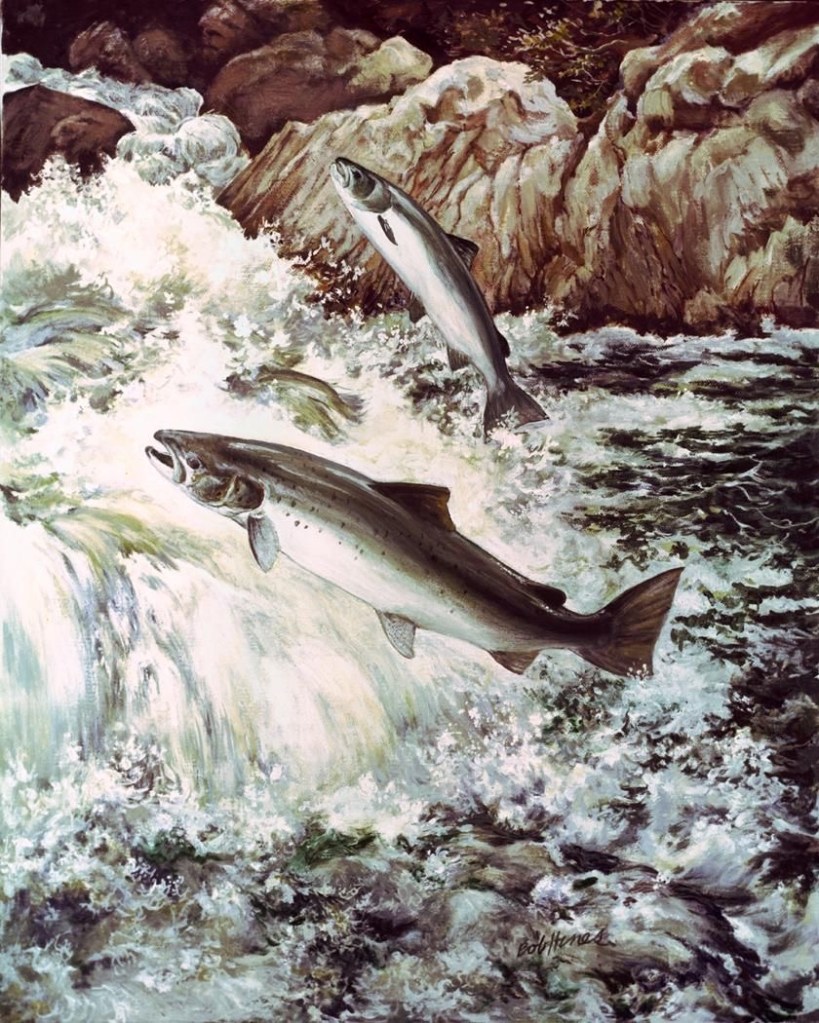
    Image: “Salmon Swimming Upstream,” artist Bob Hines, U.S. Fish and Wildlife Service, public domain via Wikimedia Commons.

    Each leap against the current is an affirmation of life’s cyclical nature. The salmon’s journey is not about victory in the conventional sense; it is about fulfilling its nature. The hardship is not separate from its purpose but an inseparable part of it. Through effort, it completes the pattern it was born into.

    Human endurance mirrors this rhythm. Like the salmon, we move through resistance not only to reach a destination but to express something essential about our being. The task is not simply to survive the current but to move within it consciously, accepting that struggle is the condition of becoming.

    Adaptation as Becoming

    Meaning emerges through engagement with adversity. Growth is not a destination but a process of becoming. Each repetition refines the individual. Every fall offers a chance to rise stronger and more aware. Adaptation is not about control but about learning to move with the weight of the world and continue forward.

    The Work of Endurance

    To live fully is to inhabit the space between struggle and peace. The mountain, the current, the climb, each represents the work of being alive. Sisyphus pushes his stone knowing the outcome yet chooses to begin again. The salmon swims knowing the journey will end, yet still commits to the ascent. In both, the act itself becomes the meaning.

    Endurance is not about triumph over difficulty but about harmony with it. To rise to adversity is to understand that struggle and growth are one. The current will always resist, but it is within that resistance that we discover who we are.

    Works Cited

    Camus, Albert. The Myth of Sisyphus and Other Essays. Translated by Justin O’Brien, Vintage International, 1991.

    U.S. Fish and Wildlife Service. “Salmon Swimming Upstream.” Artwork by Bob Hines, Public Domain, via Wikimedia Commons.
    https://commons.wikimedia.org/wiki/File:Salmon_swimming_upstream_(USFWS).jpg

    Wikimedia Commons. “Sisyphus.” Public Domain Vector Illustration.
    https://commons.wikimedia.org/wiki/File:Sisyphus_Pushing_Boulder_Vector.svg
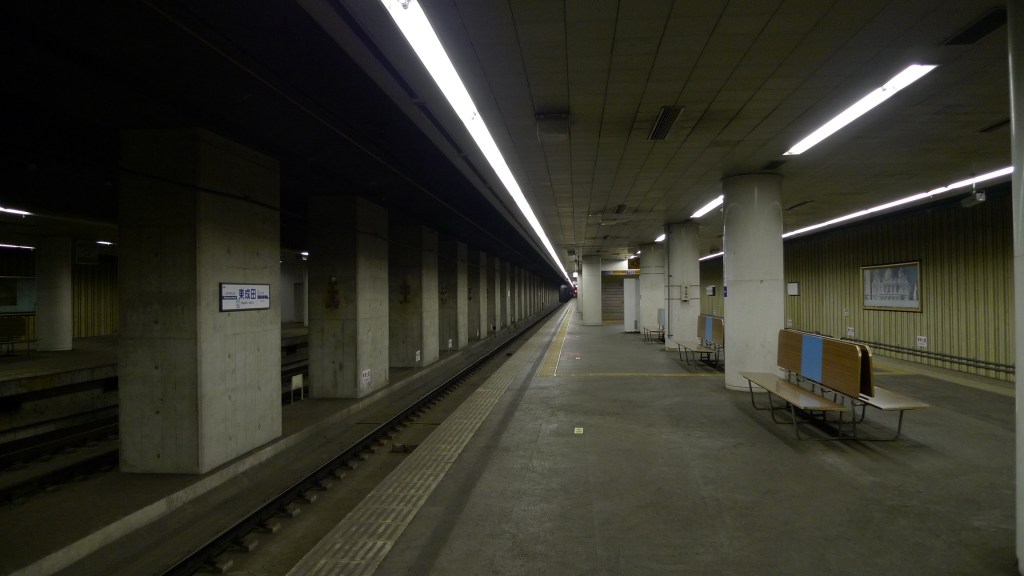
  • “Rite of Passage”

    How can liminal states be used as deliberate generative engines for positive growth instead of just passive & accidental technologies? A liminal state can be defined as a transitional “in-between” state that occurs when an individual/group is moving in between one stable condition or identity and another. In anthropology, liminality can be described as the quality of ambiguity or disorientation between rites of passage.

    (Photo: PekePON, 2011, Wikimedia Commons)

    One of my favorite depictions of a liminal state is from the movie The Matrix Reloaded. Where the protagonist Neo is trapped in the Mobile Ave subway station. Not in the Matrix, not in the machine world, he is in an “in-between” place. Neo, who has “god” like powers has suspended agency in the subway station. His passage through is contingent on approval from the conductor of the train. In this part of the movie Neo meets a program and his daughter waiting at the subway station. He begins to grapple with his relationship between humans and machines. Neo has to redefine his perspective to gain a deeper understanding of the stakes to  be allowed board of passage.

    Currently the proliferation of technology and instant information sharing is driven by transactional speed and commercial goals. The deliberate generation of liminal experience in technology can create more meaningful experience for users and to quote research on Liminal Design: A Conceptual framework “ User Experience repertoire can be enriched beyond the utilitarian . . .” . The design process in developing this user experience instead of being “static” and transactional is an evolving process that drives dynamic interaction. 

    A liminal experience can also enhance the therapeutic value of a space. The usual  interactions involving patients, family members, staff, and the physical space are now rehabilitation environments. Regarding the artistic-therapeutic environment, this quote stands out from some research on the topic. 

    “To be educated, a person does not have to know much or be informed, but he or she does have to have been exposed vulnerably to the transformative events of an engaged human life” (Moore, 1997, pg 3.) – Risk, Rupture and change: Exploring the liminal space of the Open Studio in art therapy education

    The deliberate generation of liminal experience in business, art-therapy, and art education can allow meaningful transformative change. These events that facilitate transcendence and interconnectedness can bring understanding, self-actualization, healing and positive growth.

    Works Cited:

    Liedgren, Johan, Pieter M. A. Desmet, and Andrea Gaggioli. “Liminal Design: A Conceptual Framework and Three Step Approach for Developing Technology That Delivers Transcendence and Deeper Experiences.” Frontiers in Psychology, vol. 14, 2023, article 1043170, doi:10.3389/fpsyg.2023.1043170.

    Crane, Tess, and Libby Byrne. “Risk, Rupture and Change: Exploring the Liminal Space of the Open Studio in Art Therapy Education.” Thinking Skills and Creativity, vol. 37, 2020, 100686. ScienceDirecthttps://doi.org/10.1016/j.tsc.2020.100686.

    Peteet, J.R. A Closer Look at Transcendence and Its Relationship to Mental Health. J Relig Health 57, 717–724 (2018). https://doi.org/10.1007/s10943-018-0560-zLinks to an external site.

  • Too often, the story told about generative technology is one of acceleration

    Minecraft, developed by Mojang Studios, published by Microsoft. Image from in-game capture.

    faster workflows, automated outputs, reduced costs. This is important, but it is also incomplete. By focusing only on efficiency, we risk overlooking the capacity of these tools to create spaces of transformation. . . . what anthropologists might call liminal spaces.

    A liminal experience is a threshold state: a place between stability and change, where old roles no longer apply and new ones have not yet solidified. It is uncomfortable, yes, but also profoundly generative. When professional sectors learn to integrate technologies that open these spaces intentionally, they can move beyond transactional utility toward experiences of growth, creativity, and meaning.

    Three Windows into Liminality & Generativity

    1. Education and Entrepreneurship

    Research on entrepreneurship education shows how students occupy a liminal space between being just learners and becoming entrepreneurs. In this threshold, uncertainty and identity tension are not barriers but catalysts for experimentation and growth.

    “Transformation in the liminal space ‘in between’ student and entrepreneur” (2024). Read here

    2. Generative AI in Research

    Recent scholarship on generative AI in academic research argues that these systems don’t simply speed up data analysis. Instead, they create liminal opportunities between what is already known and what might emerge. By generating patterns, hypotheses, and visualizations, AI positions researchers in a fertile “in-between” a place where meaning is not yet fixed but waiting to be discovered.

    Perkins, M., Roe, J., et al. “Generative AI Tools in Academic Research” (2024). Read here

    3. Identity Work in Academia

    Another study on the labor process in universities describes how academics often occupy liminal positions: simultaneously teacher, researcher, and administrator, yet never fully defined by any one role. In these states of ambiguity, identity work emerges as new roles and practices are negotiated.

    Oladeinde, O. “Academic Labour Process and ‘Identity Work’ Construction” (2022). Read here

    Implications for Professional Sectors

    Healthcare, law, design, and education all face similar choices. Do we integrate generative technologies only as engines of productivity or as partners in shaping meaning?

    • Healthcare: AI could be used not just for diagnostics, but to help patients and clinicians explore multiple narratives of care.
    • Design: Generative tools can force practitioners into ambiguous territory where “getting the right design” and “getting the design right” demand different modes of engagement. (Hong et al., 2023)
    • Education: Generative systems can provoke curiosity and uncertainty pushing students beyond rote answers into the liminal work of discovery.

    Across these examples, the thread is the same: technology, if deliberately designed, can generate spaces where identity, practice, and understanding are in motion.

    The philosophical tension remains unresolved. Should inspiration and meaning be treated as emergent properties of complex human-technology systems, or as fundamental human qualities that must be safeguarded in every system we build?

    What is clear is that liminal experiences hold power. When professional sectors integrate generative technology not just for speed but for depth, they create economies that invite reflection, transformation, and growth. The challenge, and opportunity lies in daring to cultivate these thresholds, rather than smoothing them away.

    Works Cited

    • Transformation in the liminal space ‘in between’ student and entrepreneur. International Journal of Management Education (2024). ScienceDirect
    • Perkins, M., Roe, J., et al. (2024). Generative AI Tools in Academic Research: Applications and Implications for Qualitative and Quantitative Research Methodologies. arXiv Preprint. arXiv PDF
    • Oladeinde, O. (2022). Academic Labour Process and ‘Identity-Work’ Construction: Liminal Experience of Academics in the University. Journal of Scientific Research & Reports. JSRR
    • Hong, M. K., Hakimi, S., Chen, Y.-Y., Toyoda, H., Wu, C., & Klenk, M. (2023). Generative AI for Product Design: Getting the Right Design and the Design Right. arXiv Preprint. arXiv Abstract