“Rite of Passage”
How can liminal states be used as deliberate generative engines for positive growth instead of just passive & accidental technologies? A liminal state can be defined as a transitional “in-between” state that occurs when an individual/group is moving in between one stable condition or identity and another. In anthropology, liminality can be described as the quality of ambiguity or disorientation between rites of passage.
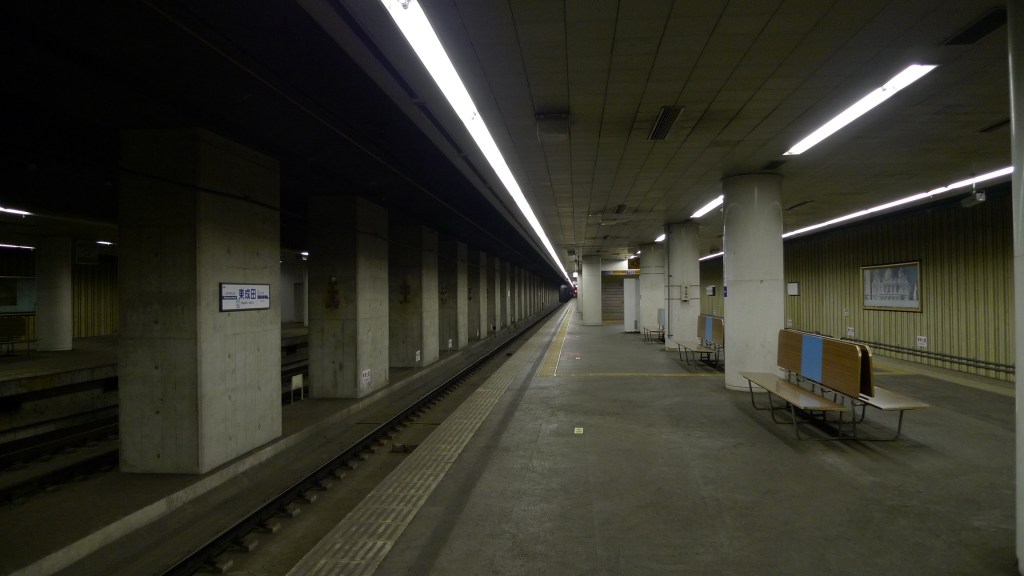
One of my favorite depictions of a liminal state is from the movie The Matrix Reloaded. Where the protagonist Neo is trapped in the Mobile Ave subway station. Not in the Matrix, not in the machine world, he is in an “in-between” place. Neo, who has “god” like powers has suspended agency in the subway station. His passage through is contingent on approval from the conductor of the train. In this part of the movie Neo meets a program and his daughter waiting at the subway station. He begins to grapple with his relationship between humans and machines. Neo has to redefine his perspective to gain a deeper understanding of the stakes to be allowed board of passage.
Currently the proliferation of technology and instant information sharing is driven by transactional speed and commercial goals. The deliberate generation of liminal experience in technology can create more meaningful experience for users and to quote research on Liminal Design: A Conceptual framework “ User Experience repertoire can be enriched beyond the utilitarian . . .” . The design process in developing this user experience instead of being “static” and transactional is an evolving process that drives dynamic interaction.
A liminal experience can also enhance the therapeutic value of a space. The usual interactions involving patients, family members, staff, and the physical space are now rehabilitation environments. Regarding the artistic-therapeutic environment, this quote stands out from some research on the topic.
“To be educated, a person does not have to know much or be informed, but he or she does have to have been exposed vulnerably to the transformative events of an engaged human life” (Moore, 1997, pg 3.) – Risk, Rupture and change: Exploring the liminal space of the Open Studio in art therapy education
The deliberate generation of liminal experience in business, art-therapy, and art education can allow meaningful transformative change. These events that facilitate transcendence and interconnectedness can bring understanding, self-actualization, healing and positive growth.
Works Cited:
Liedgren, Johan, Pieter M. A. Desmet, and Andrea Gaggioli. “Liminal Design: A Conceptual Framework and Three Step Approach for Developing Technology That Delivers Transcendence and Deeper Experiences.” Frontiers in Psychology, vol. 14, 2023, article 1043170, doi:10.3389/fpsyg.2023.1043170.
Crane, Tess, and Libby Byrne. “Risk, Rupture and Change: Exploring the Liminal Space of the Open Studio in Art Therapy Education.” Thinking Skills and Creativity, vol. 37, 2020, 100686. ScienceDirect, https://doi.org/10.1016/j.tsc.2020.100686.
Peteet, J.R. A Closer Look at Transcendence and Its Relationship to Mental Health. J Relig Health 57, 717–724 (2018). https://doi.org/10.1007/s10943-018-0560-zLinks to an external site.
 Fernando Alcala Jr.
Leave a comment