“Here we go again…again.”

Albert Camus’ interpretation of The Myth of Sisyphus is not a story of despair but of conscious endurance. Condemned to push a boulder up a mountain only for it to roll back each time, Sisyphus lives in a space between purpose and absurdity. In that tension he finds freedom. Camus writes that one must imagine Sisyphus happy because by accepting his task and continuing, he becomes greater than his punishment.
Rising to Adversity
Adversity is inevitable. Rising to it is not about escaping struggle but engaging it fully. The act of pushing forward transforms suffering into strength. Adaptation is not surrender but rebellion. We change not because success is guaranteed but because the effort itself gives meaning. Each moment of resistance is a choice to participate in life rather than yield to despair.
Commitment and Acceptance
To accept the task at hand is not resignation but awareness. Acceptance means choosing to face the mountain again. Commitment becomes the anchor of growth. The repetition is not meaningless when approached consciously; it becomes practice, a rhythm through which the self is shaped. Progress is not always upward, but persistence keeps the spirit alive.
The Salmon’s Ascent
Few natural examples express endurance more powerfully than the salmon’s journey upstream. After years in the open ocean, the salmon returns to the river of its birth, swimming against the relentless current, leaping over rapids, and enduring exhaustion and predation. It does not question the struggle. The act of returning is instinctual, purposeful, and final.
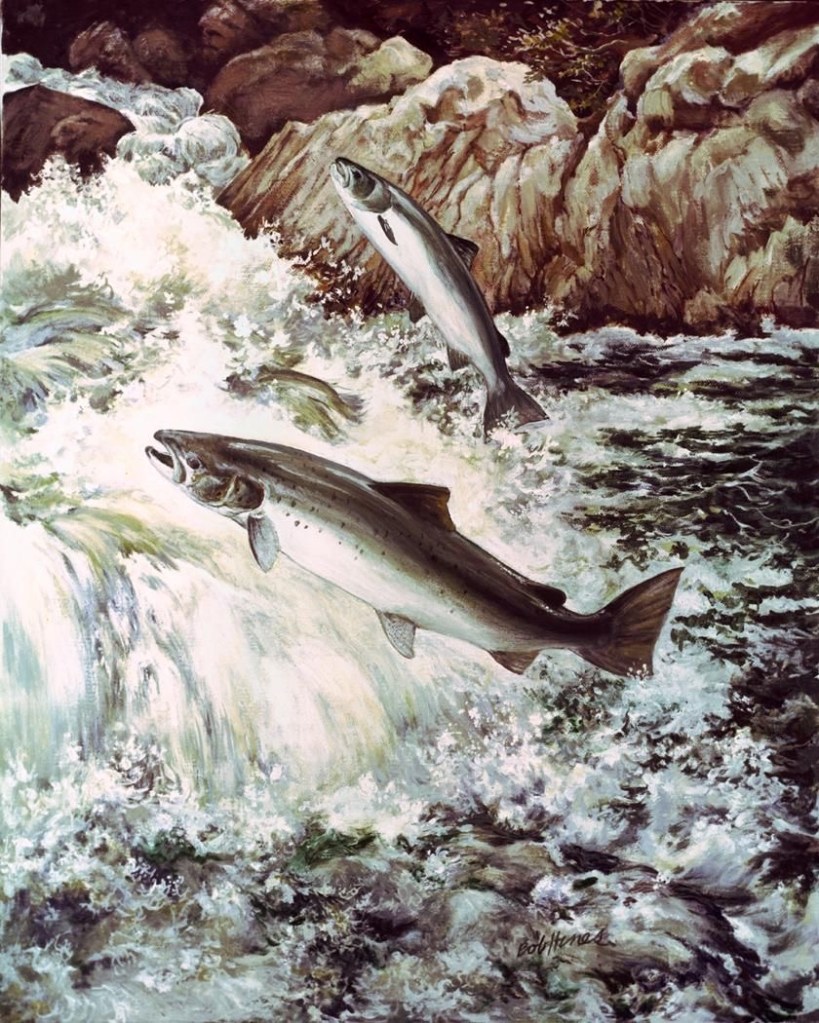
Each leap against the current is an affirmation of life’s cyclical nature. The salmon’s journey is not about victory in the conventional sense; it is about fulfilling its nature. The hardship is not separate from its purpose but an inseparable part of it. Through effort, it completes the pattern it was born into.
Human endurance mirrors this rhythm. Like the salmon, we move through resistance not only to reach a destination but to express something essential about our being. The task is not simply to survive the current but to move within it consciously, accepting that struggle is the condition of becoming.
Adaptation as Becoming
Meaning emerges through engagement with adversity. Growth is not a destination but a process of becoming. Each repetition refines the individual. Every fall offers a chance to rise stronger and more aware. Adaptation is not about control but about learning to move with the weight of the world and continue forward.
The Work of Endurance
To live fully is to inhabit the space between struggle and peace. The mountain, the current, the climb, each represents the work of being alive. Sisyphus pushes his stone knowing the outcome yet chooses to begin again. The salmon swims knowing the journey will end, yet still commits to the ascent. In both, the act itself becomes the meaning.
Endurance is not about triumph over difficulty but about harmony with it. To rise to adversity is to understand that struggle and growth are one. The current will always resist, but it is within that resistance that we discover who we are.
Works Cited
Camus, Albert. The Myth of Sisyphus and Other Essays. Translated by Justin O’Brien, Vintage International, 1991.
U.S. Fish and Wildlife Service. “Salmon Swimming Upstream.” Artwork by Bob Hines, Public Domain, via Wikimedia Commons.
https://commons.wikimedia.org/wiki/File:Salmon_swimming_upstream_(USFWS).jpg
Wikimedia Commons. “Sisyphus.” Public Domain Vector Illustration.
https://commons.wikimedia.org/wiki/File:Sisyphus_Pushing_Boulder_Vector.svg
 Fernando Alcala Jr.
.jpg)

Leave a comment